Tuesday, November 03, 2026

Two M160s, a stairwell and a Binson: the Levee drums

The version everyone knows goes like this. December 1970, Headley Grange, John Bonham’s brand new Ludwig kit set up at the bottom of the stairwell, and engineer Andy Johns hanging two Beyerdynamic M160s a couple of floors up. All true, but it leaves out the part Johns himself kept bringing up.

He ran the two mics through a pair of limiters (Vintage King’s write-up says they were Helios F760s in the Rolling Stones’ mobile truck) and then sent the drums through Jimmy Page’s Binson Echorec. In his MusicRadar interview he’s pretty blunt about where that lurching “ga-gack” comes from: “It was the Binson that made him sound like that.”

The song was also recorded at a different speed and slowed down afterwards, which goes a long way toward explaining why the whole track feels like it’s wading through mud. Rick Beato made a video a while back arguing the stairwell gets more credit than it deserves. His comments section did not take it well.

Why the M160? It’s a double-ribbon hypercardioid that’s been in production since 1952. The tight pattern means a pair hung high picks up the kit and the space without turning to mush, and it’s dark enough that the cymbals don’t get nasty once you start leaning on a limiter.

Trying it at home

You don’t need a stairwell. Put one mic well away from the kit (a hallway works), hit a limiter hard enough that you can hear it breathe, and print a short tape-style echo underneath. Then play slower and heavier than feels right. Johns said it himself: for the rest of it, you really need Bonzo.

Watch and read

Monday, November 02, 2026

Before you send a song to be mixed

Most of the problems on a new mix have nothing to do with how the song was recorded. They’re file problems. Here’s what makes the first pass go well.

  • Export every track from the same start point (bar 1, or zero) so everything lines up when it’s dropped in. Even the tambourine that only shows up in the last chorus.
  • Keep the session’s sample rate. If you tracked at 48k, send 48k. 24-bit WAV or better.
  • Turn off everything on your master bus. Limiters especially.
  • If a plugin is part of the sound (the amp sim, the weird delay on the vocal), print it, and send a dry version too.
  • Name things like a person will read them. “Gtr L crunch” beats “Audio 14_03”.
  • Consolidate your comps. We don’t need all 30 takes, just the one you picked.
  • Send your rough mix. It’s the most useful file in the folder, because it tells us what you’ve been hearing for the last six months.
  • Write a few lines about the song. Reference tracks help. “Like this, but not that part” helps even more.

About loud roughs

If your rough has a limiter on it, the first mix back can sound smaller next to it even when it’s better. Turn them to the same level before you judge. Loudness gets set in mastering.

If you’re not sure about any of this, send what you have and ask. It’s easier to sort out before the mix starts than after.

Saturday, October 31, 2026

Bruce Swedien’s SM7

Shure brought out the SM7 in 1973 as a broadcast mic. A decade later Bruce Swedien was using one on most of Michael Jackson’s lead vocals, including “Billie Jean” and “The Way You Make Me Feel.” He told Sound On Sound the choice raised some eyebrows at the time. He owned six of them.

The part worth stealing is less about the mic and more about the habit. Swedien said he used the same mic and the same preamp for Jackson’s vocals throughout the album. Every song was sung into one chain, so the voice sounds like the same person in the same room from the first track to the last. On a self-recorded EP, that kind of consistency usually matters more than which mic you buy.

The SM7 is on plenty of other records too. Bruce Dickinson on The Number of the Beast, Anthony Kiedis on Blood Sugar Sex Magik, and Jack White’s vocals from Icky Thump on. The current model is the SM7B. Close relative, not the identical early-’80s mic.

Tracking with one

It’s a quiet mic and it needs a lot of clean gain, somewhere around 60 dB for a normal singer, which is why people pair it with a Cloudlifter or another inline booster. Sing close. It forgives a bad room better than most condensers, which is probably how podcasters found it.

Watch and read

Friday, October 30, 2026

The dolceola, and a credit that stuck for 70 years

The dolceola is a small zither with a keyboard bolted on, made by the Toledo Symphony Company between about 1903 and 1908. Fewer than fifty are thought to survive. It’s a strange, lovely thing that sounds like a piano and an autoharp having a disagreement.

For a long time it was famous for one reason. It was supposedly the instrument on Washington Phillips’ gospel sides for Columbia, cut between 1927 and 1929. Those records are gorgeous, and nearly every reissue repeated the dolceola credit.

Then in 2002 Michael Corcoran, writing for the Austin American-Statesman, started pulling at the thread, and instrument collector Gregg Miner kept going. Their conclusion: Phillips played fretless zithers he built himself, not a factory dolceola. If you want to hear the real thing on record, Paul Howard plays one on Lead Belly’s 1944 Capitol sessions, and Ry Cooder used one in the ’70s.

We like this story because it’s a good reminder. Gear credits get copied from liner note to liner note and article to article. Where we can, we link the source so you can check our work too.

Watch and read

Wednesday, October 28, 2026

Ribbon plus 57 on a guitar cab

Royer released the R-121 in 1998. Back then ribbons were mostly something you found in the closet of an older studio, and the R-121 is a big part of why they came back into everyday use, especially on electric guitar.

Engineer Ross Hogarth was one of the first to pair it with a Shure SM57 on the same speaker. The 57 brings the bite, the ribbon brings the low mids and a softer top, and you blend to taste. Hogarth described his video series on it as a way to “crack the code.” Steve Genewick used the same pair on every guitar amp on Spinal Tap II, according to Mix, and Royer’s library has Slash’s Marshall miked the same way.

Getting the two mics to agree

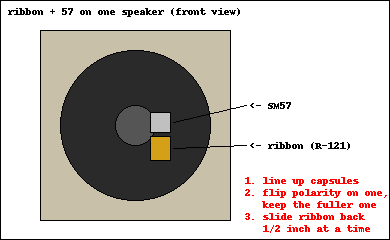
Ribbon and SM57 placement on one guitar speaker

It’s all phase. Put both mics on the same spot on the cone, with the capsules as close to lined up as you can get them. Solo both, flip the polarity on one, and keep whichever setting sounds fuller. Then move the ribbon back half an inch at a time while you listen in mono.

Two things about ribbons. The back of the mic hears as much as the front, so whatever is behind it ends up on the track. And loud is fine, but a blast of air (a kick drum port, a bass cab with no grille) is not.

Watch and read

Tuesday, October 27, 2026

A compressor from Ogden, Utah that sounds like Memphis

Spectra Sonics was founded in Ogden, Utah in 1964 by William G. Dilley. It’s not where you’d guess a Memphis soul sound came from, but Spectra’s 101 preamps get described as exactly that: the sound of Stax Records. Spectra consoles also ended up at Ardent in Memphis, the Record Plant in New York, and much later at Dan Auerbach’s Easy Eye Sound in Nashville.

The 610 Complimiter came out in 1969. It pairs a compressor/limiter module with 101-style make-up gain, and it’s fast. The published attack time runs from 100 nanoseconds to 2 microseconds, which is quicker than almost anything else you’re likely to plug in.

That kind of speed can be ugly in the wrong place and great in the right one. Dave Cobb has been loud about liking them. Vintage King quotes him: “I used the hell out of them on the new Jason Isbell record.” Vance Powell and Tchad Blake are fans too.

Where it works

Drum rooms, mostly. Something that grabs that quickly turns a room mic into a wall. It’s also good on bass when you want every note to sit exactly where it is.

Watch and read

Saturday, October 24, 2026

Once you notice the J-45, it’s on everything

Gibson introduced the J-45 in 1942, and the nickname “The Workhorse” stuck. It’s a round-shouldered dreadnought without the huge low end of a square-shouldered Martin. What it has instead is a dry, punchy midrange that sits in front of a band without much help.

A short and very incomplete list of people who’ve played one. Woody Guthrie. Buddy Holly, whose early J-45 is in the MoPOP collection in Seattle. Bob Dylan, all over the early albums and back on a sunburst J-45 since the mid ’90s. John Lennon learned fingerpicking from Donovan in Rishikesh in 1968, on Donovan’s J-45. Elliott Smith. Gillian Welch, Lucinda Williams, Steve Earle, Jeff Tweedy, Phoebe Bridgers.

Recording one

Because the guitar is already mid-forward, scooping the mids to make it sound expensive usually makes it worse. Start with a small-diaphragm condenser pointed around the 12th fret, eight to twelve inches out, and add a second mic a few feet back if your room is any good. If it sounds thin, move the mic before you touch the EQ.

Watch and read

Thursday, October 22, 2026

The RS124, an Altec that EMI took apart

In 1959 EMI bought a batch of Altec 436B compressors for Abbey Road. By 1960 three of its engineers, Bill Livy, Len Page and Mike Batchelor, had reworked them enough to give them a new name: the RS124. It’s a variable-mu tube design. Slow, smooth, and more about tone than catching peaks.

According to Recording The Beatles by Kevin Ryan and Brian Kehew, an RS124 may have been used on every Beatles album from Please Please Me to Abbey Road. The Shadows and The Zombies went through them too, and they did duty on the mix bus and in the cutting rooms. From Revolver on, Geoff Emerick also leaned hard on a Fairchild.

Chandler Limited, in Shell Rock, Iowa, is the one company licensed to make official EMI and Abbey Road gear. Their RS124 recreation was modeled on three surviving originals, which matters, since no two vintage units sound quite the same.

How we’d use one

Bass and vocals. Two or three dB of gain reduction, slow release. It isn’t going to flatten anything. It makes things sound settled, which is a different job.

Watch and read

Tuesday, October 20, 2026

The Sears amp with the most indie cred

Sears sold the Silvertone 1484 “Twin Twelve” from 1963 to 1967, and Danelectro built it. It’s a piggyback head and cab, somewhere around 50 or 60 watts into two 12-inch speakers, with tube tremolo and reverb. It was meant for a kid’s bedroom or a church basement.

Mudhoney’s Mark Arm and Steve Turner were on them early. Jack White did more than anyone to make them expensive. Reverb’s page on the JHS clone runs through Beck, Death Cab for Cutie, Vampire Weekend and The White Stripes and calls it about as indie as a vintage amp gets, which is hard to argue with. Premier Guitar’s review of the Jackson Audio version puts it in the backline of punks and garage bands.

It’s loose, a little hairy even when it’s clean, and it breaks up early. The low end gets flubby when you push it, which is charming right up until it isn’t.

Recording one

Don’t fight the looseness. Back the mic off a few inches from the grille, keep the gain lower than you think, and let the bass and drums carry the bottom. A 57 is fine. A ribbon a few feet back is better.

Watch and read

Saturday, October 17, 2026

“+12 on every EQ”: how Rumours stopped sounding wrong

Fleetwood Mac tracked much of Rumours at the Record Plant in Sausalito, in Studio B, on an API console with 550A EQs, going to 3M 24-track tape. Ken Caillat and Richard Dashut produced and engineered alongside the band.

The first days didn’t go well. As Vintage King’s write-up tells it, Caillat spent about nine days moving mics and swapping amps and still didn’t like what he heard. What finally fixed it was the desk: opening up the preamps and, in his words, “+12 on every EQ channel.”

For mics, Caillat told Sound On Sound he used a Sennheiser 441 on kick, an AKG C414 with a 20 dB pad on snare and AKG 451s overhead, with the bass through a DI and a 414. Nothing exotic.

Big boosts aren’t a crime

The 550A uses what API calls proportional Q. The more you boost, the narrower the band gets, so small moves are broad and gentle and big moves get more focused. That’s a large part of why you can push one hard and it still sounds like music. If you’ve been told to only ever cut, try a bold boost on something that sounds dull and see what happens.

Watch and read

Thursday, October 15, 2026

The BBC ribbon over Ringo’s kit

The 4038 started out as a BBC design in the 1950s. STC built it first, and Coles has made it since the mid ’70s with the same specs. It looks a bit like a small waffle iron and it sounds dark, wide and very natural, especially on loud things.

At Abbey Road, Norman Smith used a pair as overheads on Ringo Starr’s kit, and Geoff Emerick kept experimenting with them. Ken Scott told Sound On Sound he used one on Paul McCartney’s bass cab and on the Hammond during the Sgt. Pepper and White Album sessions. Glyn Johns’ well-known drum setup often used two of them, and they’re on Pink Floyd’s The Piper at the Gates of Dawn too.

A Glyn Johns-style setup

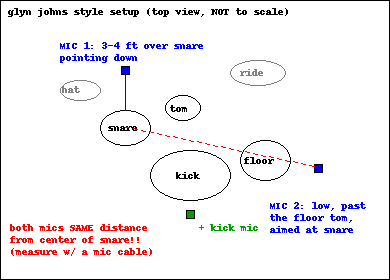
Glyn Johns style drum mic setup, top view

Excuse the drawing.

One mic three or four feet above the snare, pointing down. A second just past the floor tom, low, looking across the kit toward the snare. Use a mic cable as a tape measure to get both the same distance from the center of the snare, then add a kick mic. It’s simple and very hard to make sound bad. With 4038s you’ll want a preamp with plenty of clean gain.

Watch and read

Tuesday, October 13, 2026

A newer one: the Highland Dynamics BG2

Highland Dynamics is Bryce Gonzales in Los Angeles. Before this he built the Lisson Grove AR-1. The BG2 is a mono, all-tube variable-mu compressor, transformer-balanced and wired point to point.

It has two feedback modes. “British” is the cleaner one and “American” adds more harmonics. There’s also a line-amp mode for when you just want to run something through the tubes and transformers without compressing it.

Sound On Sound’s review called it astoundingly good on vocals. John Vanderslice, who runs Tiny Telephone in the Bay Area, told Vintage King they keep a BG1 and a BG2 in both rooms. That’s a decent endorsement from a place that has tracked a lot of indie records.

On a vocal

Set it so the loudest lines get three or four dB of reduction and then leave it alone. Variable-mu compression gets gentler as the signal drops, so the quiet lines barely get touched. Try both modes on the same take before you decide.

Watch and read

Saturday, October 10, 2026

Crooners, Les Paul and the RCA 44

The RCA 44 is the mic you picture when you picture 1940s radio. It’s a figure-8 ribbon, and when Bing Crosby leaned in close, the proximity effect gave him the warm, intimate low end that became crooning. Frank Sinatra sang into them early on. Les Paul used a 44-BX when he recorded “How High the Moon” in 1951.

RCA stopped making them a long time ago. AEA, in Pasadena, started servicing RCA ribbons in 1976, and by 1998 it could make every part of a 44 itself. That became the R44C, a replica of the 1936–38 44-BX. Les Paul told AEA’s Wes Dooley it was his favorite mic, and Eddie Van Halen bought a pair to record drums in stereo.

Singing into one

Distance is the tone control. Close in, you get the low-end bloom. Step back a foot and it thins out and the room comes in. Because it’s a figure-8, the back hears just as well as the front, so think about what’s behind it. Give it a preamp with a lot of clean gain.

Watch and read

Thursday, October 08, 2026

Lenny Kravitz or Beck? Two tube preamps from Kansas

Coil Audio is a small company in Lawrence, Kansas that builds tube mic preamps from very old circuits.

The CA-70 is a two-stage octal tube design (a 6J7 into a 6C5) based on the Western Electric circuit that RCA, Gates and Langevin all built versions of. It’s thick and creamy, heavy in the lows. The CA-286 uses a two-stage EF86 circuit in the same family as the Telefunken V72 and the old Langevin, Collins and Gates broadcast amps. It’s more forward and detailed, with a bit of edge.

Tape Op’s reviewer put it about as well as anyone could: “CA-286 would be Lenny Kravitz, CA-70 would be Beck.” Vance Powell, who has engineered for Jack White and Chris Stapleton, keeps CA-286 modules in his rack.

One practical note. Neither one supplies phantom power, so condenser mics need it from somewhere else.

Watch and read

Subscribe to: Posts (RSS)