Showing posts with label guitars. Show all posts

Wednesday, October 28, 2026

Ribbon plus 57 on a guitar cab

Royer released the R-121 in 1998. Back then ribbons were mostly something you found in the closet of an older studio, and the R-121 is a big part of why they came back into everyday use, especially on electric guitar.

Engineer Ross Hogarth was one of the first to pair it with a Shure SM57 on the same speaker. The 57 brings the bite, the ribbon brings the low mids and a softer top, and you blend to taste. Hogarth described his video series on it as a way to “crack the code.” Steve Genewick used the same pair on every guitar amp on Spinal Tap II, according to Mix, and Royer’s library has Slash’s Marshall miked the same way.

Getting the two mics to agree
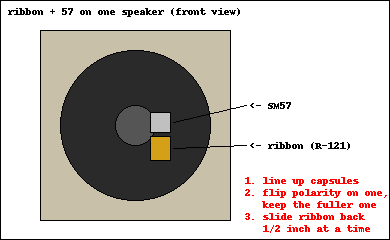
Ribbon and SM57 placement on one guitar speaker

It’s all phase. Put both mics on the same spot on the cone, with the capsules as close to lined up as you can get them. Solo both, flip the polarity on one, and keep whichever setting sounds fuller. Then move the ribbon back half an inch at a time while you listen in mono.

Two things about ribbons. The back of the mic hears as much as the front, so whatever is behind it ends up on the track. And loud is fine, but a blast of air (a kick drum port, a bass cab with no grille) is not.

Watch and read

Saturday, October 24, 2026

Once you notice the J-45, it’s on everything

Gibson introduced the J-45 in 1942, and the nickname “The Workhorse” stuck. It’s a round-shouldered dreadnought without the huge low end of a square-shouldered Martin. What it has instead is a dry, punchy midrange that sits in front of a band without much help.

A short and very incomplete list of people who’ve played one. Woody Guthrie. Buddy Holly, whose early J-45 is in the MoPOP collection in Seattle. Bob Dylan, all over the early albums and back on a sunburst J-45 since the mid ’90s. John Lennon learned fingerpicking from Donovan in Rishikesh in 1968, on Donovan’s J-45. Elliott Smith. Gillian Welch, Lucinda Williams, Steve Earle, Jeff Tweedy, Phoebe Bridgers.

Recording one

Because the guitar is already mid-forward, scooping the mids to make it sound expensive usually makes it worse. Start with a small-diaphragm condenser pointed around the 12th fret, eight to twelve inches out, and add a second mic a few feet back if your room is any good. If it sounds thin, move the mic before you touch the EQ.

Watch and read

Tuesday, October 20, 2026

The Sears amp with the most indie cred

Sears sold the Silvertone 1484 “Twin Twelve” from 1963 to 1967, and Danelectro built it. It’s a piggyback head and cab, somewhere around 50 or 60 watts into two 12-inch speakers, with tube tremolo and reverb. It was meant for a kid’s bedroom or a church basement.

Mudhoney’s Mark Arm and Steve Turner were on them early. Jack White did more than anyone to make them expensive. Reverb’s page on the JHS clone runs through Beck, Death Cab for Cutie, Vampire Weekend and The White Stripes and calls it about as indie as a vintage amp gets, which is hard to argue with. Premier Guitar’s review of the Jackson Audio version puts it in the backline of punks and garage bands.

It’s loose, a little hairy even when it’s clean, and it breaks up early. The low end gets flubby when you push it, which is charming right up until it isn’t.

Recording one

Don’t fight the looseness. Back the mic off a few inches from the grille, keep the gain lower than you think, and let the bass and drums carry the bottom. A 57 is fine. A ribbon a few feet back is better.

Watch and read

Subscribe to: Posts (RSS)