Showing posts with label indie. Show all posts

Thursday, October 22, 2026

The RS124, an Altec that EMI took apart

In 1959 EMI bought a batch of Altec 436B compressors for Abbey Road. By 1960 three of its engineers, Bill Livy, Len Page and Mike Batchelor, had reworked them enough to give them a new name: the RS124. It’s a variable-mu tube design. Slow, smooth, and more about tone than catching peaks.

According to Recording The Beatles by Kevin Ryan and Brian Kehew, an RS124 may have been used on every Beatles album from Please Please Me to Abbey Road. The Shadows and The Zombies went through them too, and they did duty on the mix bus and in the cutting rooms. From Revolver on, Geoff Emerick also leaned hard on a Fairchild.

Chandler Limited, in Shell Rock, Iowa, is the one company licensed to make official EMI and Abbey Road gear. Their RS124 recreation was modeled on three surviving originals, which matters, since no two vintage units sound quite the same.

How we’d use one

Bass and vocals. Two or three dB of gain reduction, slow release. It isn’t going to flatten anything. It makes things sound settled, which is a different job.

Watch and read

Tuesday, October 20, 2026

The Sears amp with the most indie cred

Sears sold the Silvertone 1484 “Twin Twelve” from 1963 to 1967, and Danelectro built it. It’s a piggyback head and cab, somewhere around 50 or 60 watts into two 12-inch speakers, with tube tremolo and reverb. It was meant for a kid’s bedroom or a church basement.

Mudhoney’s Mark Arm and Steve Turner were on them early. Jack White did more than anyone to make them expensive. Reverb’s page on the JHS clone runs through Beck, Death Cab for Cutie, Vampire Weekend and The White Stripes and calls it about as indie as a vintage amp gets, which is hard to argue with. Premier Guitar’s review of the Jackson Audio version puts it in the backline of punks and garage bands.

It’s loose, a little hairy even when it’s clean, and it breaks up early. The low end gets flubby when you push it, which is charming right up until it isn’t.

Recording one

Don’t fight the looseness. Back the mic off a few inches from the grille, keep the gain lower than you think, and let the bass and drums carry the bottom. A 57 is fine. A ribbon a few feet back is better.

Watch and read

Thursday, October 15, 2026

The BBC ribbon over Ringo’s kit

The 4038 started out as a BBC design in the 1950s. STC built it first, and Coles has made it since the mid ’70s with the same specs. It looks a bit like a small waffle iron and it sounds dark, wide and very natural, especially on loud things.

At Abbey Road, Norman Smith used a pair as overheads on Ringo Starr’s kit, and Geoff Emerick kept experimenting with them. Ken Scott told Sound On Sound he used one on Paul McCartney’s bass cab and on the Hammond during the Sgt. Pepper and White Album sessions. Glyn Johns’ well-known drum setup often used two of them, and they’re on Pink Floyd’s The Piper at the Gates of Dawn too.

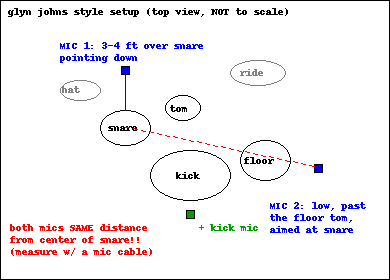
A Glyn Johns-style setup

Glyn Johns style drum mic setup, top view

Excuse the drawing.

One mic three or four feet above the snare, pointing down. A second just past the floor tom, low, looking across the kit toward the snare. Use a mic cable as a tape measure to get both the same distance from the center of the snare, then add a kick mic. It’s simple and very hard to make sound bad. With 4038s you’ll want a preamp with plenty of clean gain.

Watch and read

Tuesday, October 13, 2026

A newer one: the Highland Dynamics BG2

Highland Dynamics is Bryce Gonzales in Los Angeles. Before this he built the Lisson Grove AR-1. The BG2 is a mono, all-tube variable-mu compressor, transformer-balanced and wired point to point.

It has two feedback modes. “British” is the cleaner one and “American” adds more harmonics. There’s also a line-amp mode for when you just want to run something through the tubes and transformers without compressing it.

Sound On Sound’s review called it astoundingly good on vocals. John Vanderslice, who runs Tiny Telephone in the Bay Area, told Vintage King they keep a BG1 and a BG2 in both rooms. That’s a decent endorsement from a place that has tracked a lot of indie records.

On a vocal

Set it so the loudest lines get three or four dB of reduction and then leave it alone. Variable-mu compression gets gentler as the signal drops, so the quiet lines barely get touched. Try both modes on the same take before you decide.

Watch and read

Thursday, October 08, 2026

Lenny Kravitz or Beck? Two tube preamps from Kansas

Coil Audio is a small company in Lawrence, Kansas that builds tube mic preamps from very old circuits.

The CA-70 is a two-stage octal tube design (a 6J7 into a 6C5) based on the Western Electric circuit that RCA, Gates and Langevin all built versions of. It’s thick and creamy, heavy in the lows. The CA-286 uses a two-stage EF86 circuit in the same family as the Telefunken V72 and the old Langevin, Collins and Gates broadcast amps. It’s more forward and detailed, with a bit of edge.

Tape Op’s reviewer put it about as well as anyone could: “CA-286 would be Lenny Kravitz, CA-70 would be Beck.” Vance Powell, who has engineered for Jack White and Chris Stapleton, keeps CA-286 modules in his rack.

One practical note. Neither one supplies phantom power, so condenser mics need it from somewhere else.

Watch and read

Subscribe to: Posts (RSS)